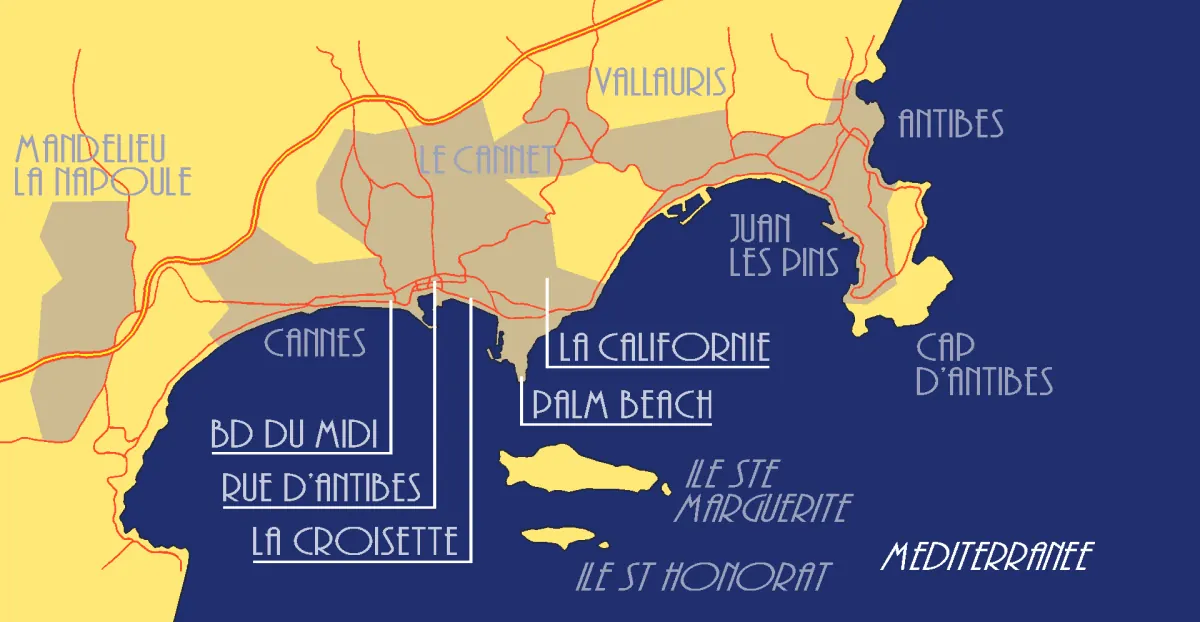
The town first grew around the harbour and on the hill of Le Suquet, beneath the castle of the abbots of Lérins. About 5,000 people lived in these narrow, sometimes steep lanes on the eve of the Revolution. Everything changed after 1834, when Lord Brougham settled in Cannes and brought the British aristocracy in his wake. Villas spread over the hills, the seafront path became the Croisette, and the opening of the Palais des Festivals in 1982 crowned one of the best-known boulevards in the world.
Le Suquet, the old town
The visit starts at the foot of the hill, in front of the town hall and the Forville market. Open in the morning, and given over to a flea market on Mondays, it is the belly of Cannes: local fish, vegetables from the hinterland, socca and flowers. Next door, Rue Meynadier is lined with food shops.
From there, climb Rue Saint-Antoine, with its row of restaurants, to Place de la Castre. Here stand the church of Notre-Dame d'Espérance, in Provençal Gothic style and completed in the 17th century, the Sainte-Anne chapel and the square tower of Le Suquet, 22 metres high. The former castle houses the Musée des explorations du monde. From the top of the tower the view takes in the bay, the Lérins Islands and the Estérel.
The old port
At the foot of Le Suquet, the Vieux Port mixes the fishermen's wooden pointus, classic sailing yachts and large motor yachts. Quai Saint-Pierre has kept its coloured façades. The plane-shaded Allées de la Liberté host boules players, a flower market and a flea market.
Shuttle boats for the Lérins Islands leave from Quai Laubeuf, at the western end. In September the basins are taken over by the Cannes Yachting Festival, then by the Régates Royales and their classic yachts.
The Palais des Festivals
Built between 1979 and 1982 on the site of the old municipal casino and extended in 1999, the Palais des Festivals et des Congrès hosts the Cannes Film Festival and dozens of trade shows every year. The Grand Auditorium Louis Lumière seats about 2,300. Its twenty-four steps, dressed in red during the Festival, stay open the rest of the year: anyone can strike a pose.
On the forecourt, the Chemin des Étoiles preserves the handprints of several hundred artists. The building also houses the tourist office and the Casino Barrière Le Croisette.
The Croisette
The name comes from a small cross that once stood at the tip of the headland, where the Palm Beach is today. A footpath followed the shore from the harbour: the "path of the little cross". The point itself was a marsh, drained in the mid-19th century. Place de l'Étang, where boules players gather, keeps the memory.
The boulevard was laid out in the 1860s. Palace hotels and casinos rose facing the sea, and the promenade became the open-air salon of polite society, a place to see and be seen. After 1946 the Festival gave it worldwide fame.
Today the Croisette runs for almost three kilometres, from the Palais to the Palm Beach. On the sea side are sandy beaches, hotel jetties and the free blue chairs. On the city side are the façades of the Majestic, the Carlton and the Martinez, luxury boutiques and the La Malmaison art centre. At the end of the day the sun sets behind the Estérel and turns the bay pink.
Rue d'Antibes and the Carré d'Or
Running parallel to the Croisette, Rue d'Antibes is the city's main shopping street. Between the two lies the Carré d'Or, a grid of boutiques, galleries, bars and restaurants where the nightlife is concentrated. See our sections on fashion and shopping and going out in Cannes.
La Californie and La Croix-des-Gardes
To the east, the hill of La Californie carries the great Belle Époque villas and the Russian Orthodox church of Saint Michael the Archangel, built in 1894 for the Russian colony. Pablo Picasso lived and worked here from 1955 to 1961, at the Villa La Californie. Lower down, the Villa Domergue and its terraced gardens, bequeathed by the painter Jean-Gabriel Domergue, open to the public in the warmer months.
To the west, the Croix-des-Gardes massif is the green lung of Cannes: 80 hectares of forest, waymarked paths and a viewpoint over the whole bay. Lord Brougham's Villa Eléonore-Louise stood at the foot of the hill.
The painted walls
Some fifteen murals devoted to cinema are scattered across the city, from Le Suquet to La Bocca: Charlie Chaplin, Marilyn Monroe, Jacques Tati, Buster Keaton and a large wall celebrating a hundred years of film near the bus station. The tourist office publishes a map of the trail.
How long to allow
One day is enough to take in the Forville market, Le Suquet, the port, the Palais and the Croisette. Allow another half-day for the Lérins Islands, and keep time for the museums. To understand what you are looking at, the history of Cannes page gives the full chronology.
Page updated on