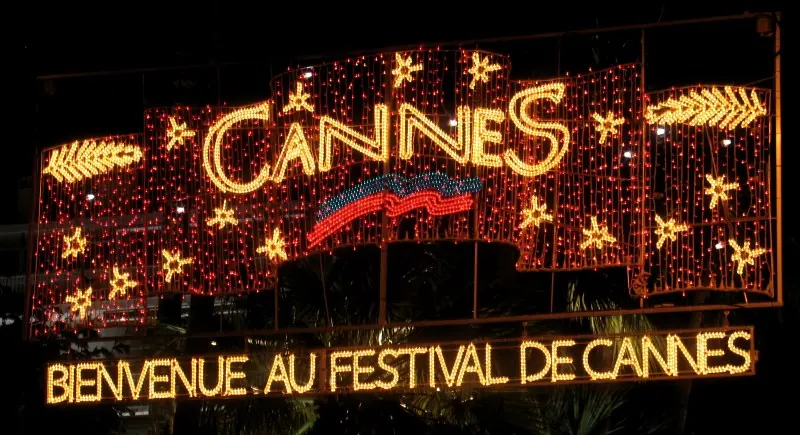
The Festival in brief
- Next edition
- 80th Festival, 11 to 22 May 2027
- Venue
- Palais des Festivals et des Congrès, 1 boulevard de la Croisette
- Latest winner
- Palme d'Or 2026: Fjord by Cristian Mungiu
- Access
- Accredited professionals and invited guests only
The Festival is a trade event: screenings in the Palais require accreditation or an invitation. The public can, however, attend the free Cinéma de la Plage screenings every evening on Macé beach, watch the red-carpet arrivals from the Croisette, and try for seats in the parallel sections, the Directors' Fortnight and Critics' Week, which sell some of their tickets. During these twelve days, hotels are fully booked months in advance.
Origins: a festival against propaganda
In 1938 the Venice Mostra, then the only major film festival in the world, gave its top prizes under pressure from Berlin and Rome to Leni Riefenstahl's Olympia and to an Italian film supervised by Mussolini's son. Delegates from the democracies left the lagoon outraged. Among them, Philippe Erlanger, head of the French Association for Artistic Action, proposed with the critics Émile Vuillermoz and René Jeanne to create in France a festival free of political pressure. The minister Jean Zay backed the project.
Biarritz, Vichy, Algiers and Cannes were candidates. Cannes won thanks to its climate, its reputation and its hotel capacity. Philippe Erlanger became the event's first general delegate.
1939-1959: the founding years
- 1939
The first International Film Festival was due to open on 1 September under the presidency of Louis Lumière. The poster was by Jean-Gabriel Domergue and Hollywood stars had already arrived by ocean liner. That day, Germany invaded Poland. The Festival was cancelled after a single private screening.
- 1946
The first edition ran from 20 September to 5 October in the old municipal casino. The spirit was one of encounter rather than competition: eleven films shared the Grand Prix, among them Jean Delannoy's La Symphonie pastorale, Roberto Rossellini's Rome, Open City and David Lean's Brief Encounter. Winners received works by contemporary artists.
- 1947
Prizes were awarded by genre. Winners included Vincente Minnelli's Ziegfeld Follies and René Clément's Les Maudits.
- 1948 and 1950
The Festival was cancelled for lack of funds.
- 1949
A festival hall was inaugurated on the Croisette, on the site of today's JW Marriott. The Grand Prix went to The Third Man by the British director Carol Reed.
- 1951
To stop competing with Venice, the Festival moved from September to spring. The Grand Prix was shared by Vittorio De Sica's Miracle in Milan and Alf Sjöberg's Miss Julie.
- 1952
Orson Welles (Othello) and Renato Castellani (Two Cents Worth of Hope) shared the Grand Prix. Marlon Brando won the acting prize for Viva Zapata!
- 1953
Grand Prix to Henri-Georges Clouzot's The Wages of Fear, with Yves Montand and Charles Vanel. On the beach, an eighteen-year-old starlet drove the photographers wild: Brigitte Bardot. Pablo Picasso, excused from black tie, climbed the steps in a sheepskin jacket.
- 1954
Grand Prix to Gate of Hell by the Japanese director Teinosuke Kinugasa. During a photo call, the actress Simone Silva removed her top beside Robert Mitchum. The picture went round the world and the scandal wrecked her career.
- 1955: birth of the Palme d'Or
The Palme d'Or, inspired by the city's coat of arms, replaced the Grand Prix. The first went to Marty by the American Delbert Mann. A guest of the Festival, Grace Kelly met Prince Rainier during a photo session arranged at the palace in Monaco. They married the following year.
- 1956
Alain Resnais's Night and Fog, about the Nazi camps, was withdrawn from competition at the request of the German embassy and shown out of competition. Palme d'Or to The Silent World by Jacques-Yves Cousteau and Louis Malle.
- 1957
Palme d'Or to William Wyler's Friendly Persuasion. The jury was chaired by André Maurois, with Jean Cocteau as honorary president and Marcel Pagnol among its members.
- 1958
Palme d'Or to The Cranes Are Flying by the Soviet director Mikhail Kalatozov. Special Jury Prize to Jacques Tati's Mon Oncle.
- 1959
Official creation of the Marché du Film, now the largest film market in the world. Palme d'Or to Marcel Camus's Black Orpheus. François Truffaut, banned from the Festival the year before for his reviews, triumphed with The 400 Blows, which won Best Director: the New Wave had arrived. André Malraux was the first Minister of Culture to come to Cannes.
1960-1979: scandals, May 68 and new sections
- 1960
Under jury president Georges Simenon, the Palme went to Federico Fellini's La Dolce Vita, condemned by the Vatican.
- 1961
The Palme was shared by Henri Colpi's The Long Absence and Luis Buñuel's Viridiana, promptly banned in Spain. Jury president: Jean Giono.
- 1962
Birth of Critics' Week, devoted to first and second films. Palme d'Or to The Given Word by the Brazilian Anselmo Duarte.
- 1963
Palme d'Or to Luchino Visconti's The Leopard, with Burt Lancaster, Alain Delon and Claudia Cardinale.
- 1964
The top award reverted for ten years to the name Grand Prix. Fritz Lang and his jury chose Jacques Demy's The Umbrellas of Cherbourg.
- 1965
Olivia de Havilland was the first woman to chair the jury. Grand Prix to Richard Lester's The Knack… and How to Get It.
- 1966
Sophia Loren presided. The Grand Prix was shared by Claude Lelouch's A Man and a Woman and Pietro Germi's The Birds, the Bees and the Italians.
- 1967
Grand Prix to Michelangelo Antonioni's Blow-Up.
- 1968
Protest reached the Croisette. On 18 May, François Truffaut, Jean-Luc Godard, Claude Lelouch, Louis Malle and others called for the Festival to stop in solidarity with striking students and workers. Film-makers withdrew their films, four jurors resigned, and one screening was prevented by directors hanging on to the curtain. The Festival was halted on 19 May, with no awards.
- 1969
As a direct consequence of May 68, the French directors' guild created the Directors' Fortnight, an independent, non-competitive section. Grand Prix to Lindsay Anderson's If….
- 1970
Grand Prix to Robert Altman's M*A*S*H.
- 1971
For its twenty-fifth anniversary the Festival gave Luchino Visconti a special prize for Death in Venice and his body of work. The Grand Prix went to Joseph Losey's The Go-Between. Charlie Chaplin was made a Commander of the Legion of Honour.
- 1972
A decisive turning point: the Festival now chose the films itself, where each country had previously nominated its own. The Grand Prix was shared by Elio Petri's The Working Class Goes to Heaven and Francesco Rosi's The Mattei Affair.
- 1973
A year of scandals. Marco Ferreri's La Grande Bouffe and Jean Eustache's The Mother and the Whore violently divided the Croisette. Ingrid Bergman's jury split the Grand Prix between Jerry Schatzberg's Scarecrow and Alan Bridges's The Hireling.
- 1974
Grand Prix to Francis Ford Coppola's The Conversation. Jack Nicholson won Best Actor for The Last Detail.
- 1975
The Palme d'Or returned. It went to Chronicle of the Years of Fire by the Algerian Mohammed Lakhdar-Hamina. Jeanne Moreau chaired the jury.
- 1976
Palme d'Or to Martin Scorsese's Taxi Driver, to boos from part of the audience. Tennessee Williams presided.
- 1977
Roberto Rossellini secured the Palme for the Taviani brothers' Padre Padrone, a film produced for television, against the wishes of the Festival's management.
- 1978
Gilles Jacob became general delegate. He created the Un Certain Regard section and the Caméra d'Or, awarded to the best first film across all sections. Palme d'Or to Ermanno Olmi's The Tree of Wooden Clogs.
- 1979
The Palme was shared by Francis Ford Coppola's Apocalypse Now and Volker Schlöndorff's The Tin Drum. The jury president, Françoise Sagan, later denounced the pressure applied in favour of the American film.
1980-1999: the new Palais and the age of auteurs
- 1980
Kirk Douglas presided. The Palme was shared by Bob Fosse's All That Jazz and Akira Kurosawa's Kagemusha.
- 1981
Palme d'Or to Andrzej Wajda's Man of Iron, shot as Solidarity was being born.
- 1982
The last edition in the old hall. The Palme was shared by Yılmaz Güney's Yol and Costa-Gavras's Missing.
- 1983
The Festival moved into the new Palais des Festivals, quickly nicknamed "the bunker". Palme d'Or to Shōhei Imamura's The Ballad of Narayama. Photographers, snubbed by Isabelle Adjani, laid their cameras at the foot of the steps as she passed.
- 1984
Pierre Viot succeeded Robert Favre Le Bret as president. Palme d'Or to Wim Wenders's Paris, Texas.
- 1985
Palme d'Or to Emir Kusturica's When Father Was Away on Business. Jean-Luc Godard took a cream pie full in the face, courtesy of the Belgian prankster Noël Godin.
- 1986
Palme d'Or to Roland Joffé's The Mission. Grand Prix to Andrei Tarkovsky's The Sacrifice.
- 1987
For the fortieth anniversary, Yves Montand and his jury honoured Under the Sun of Satan. Booed by part of the audience, Maurice Pialat raised his fist and told the room he did not like them either. Prince Charles and Princess Diana were on an official visit.
- 1988
Palme d'Or to Pelle the Conqueror by the Dane Bille August.
- 1989
The bicentenary of the French Revolution. Wim Wenders and his jury revealed a twenty-six-year-old unknown, Steven Soderbergh, who won the Palme for Sex, Lies, and Videotape.
- 1990
Palme d'Or to David Lynch's Wild at Heart. Gérard Depardieu won Best Actor for Cyrano de Bergerac.
- 1991
Roman Polanski's jury gave a treble to the Coen brothers' Barton Fink: Palme d'Or, Best Director and Best Actor. The first Leçon de Cinéma masterclass was given by Francesco Rosi.
- 1992
A second Palme for Bille August with The Best Intentions.
- 1993
The Palme was shared by The Piano by Jane Campion, the first woman director to win it, and Chen Kaige's Farewell My Concubine.
- 1994
Clint Eastwood presided, with Catherine Deneuve as vice-president. The Palme for Pulp Fiction drew jeers, which Quentin Tarantino answered with a raised middle finger.
- 1995
Jeanne Moreau presided for the second time. A second Palme for Emir Kusturica with Underground. The Caméra d'Or revealed the Iranian Jafar Panahi and The White Balloon.
- 1996
Palme d'Or to Mike Leigh's Secrets & Lies. Grand Prix to Lars von Trier's Breaking the Waves.
- 1997
The fiftieth edition. Isabelle Adjani presided. The Palme was shared by Shōhei Imamura's The Eel and Abbas Kiarostami's Taste of Cherry. A Palme of Palmes was awarded to Ingmar Bergman.
- 1998
The Palme itself was redesigned by Caroline Scheufele of Chopard: a gold leaf resting on a crystal cushion. The Cinéfondation was created to support young film-makers. Palme d'Or to Theo Angelopoulos's Eternity and a Day. Grand Prix to Roberto Benigni's Life Is Beautiful.
- 1999
David Cronenberg's jury sprang a surprise by crowning the Dardenne brothers' Rosetta.
2000-2019: the global Festival
- 2000
Palme d'Or to Lars von Trier's Dancer in the Dark, with Björk and Catherine Deneuve. Gilles Jacob was elected president of the Festival. Thierry Frémaux took over artistic direction the following year.
- 2001
Palme d'Or to Nanni Moretti's The Son's Room. Grand Prix to Michael Haneke's The Piano Teacher.
- 2002
The International Film Festival officially adopted the name Festival de Cannes. Palme d'Or to Roman Polanski's The Pianist.
- 2003
Palme d'Or and Best Director to Gus Van Sant's Elephant. Jury president: Patrice Chéreau.
- 2004
Quentin Tarantino and his jury gave the Palme to Michael Moore's documentary Fahrenheit 9/11. Grand Prix to Park Chan-wook's Oldboy. Cannes Classics, a showcase for restored films, was created.
- 2005
A second Palme for the Dardenne brothers with L'Enfant.
- 2006
Palme d'Or to Ken Loach's The Wind That Shakes the Barley. The actors of Days of Glory received a collective acting prize.
- 2007
The sixtieth edition. Thirty-five film-makers each contributed a three-minute short to the collective film To Each His Own Cinema. Palme d'Or to Cristian Mungiu's 4 Months, 3 Weeks and 2 Days.
- 2008
Sean Penn presided. Laurent Cantet's The Class brought the Palme back to France, twenty-one years after Pialat.
- 2013
Steven Spielberg's jury awarded the Palme to Blue Is the Warmest Colour, naming its two actresses, Adèle Exarchopoulos and Léa Seydoux, alongside the director Abdellatif Kechiche. A first.
- 2019
Bong Joon-ho's Parasite won the Palme by unanimous vote, before going on to take the Oscar for Best Picture.
Since 2020: the pause and the return
- 2020
The Covid-19 pandemic led to the cancellation of the edition, for the first time since 1950. A list of films received the "Cannes 2020" label.
- 2021
The Festival was held exceptionally in July. With Titane, Julia Ducournau became the second woman director to win the Palme d'Or.
- 2022
The seventy-fifth edition. Iris Knobloch was elected president of the Festival, the first woman in the post.
- 2023
Anatomy of a Fall won the Palme for Justine Triet, the third woman director to receive it.
- 2025
Thirty years after his Caméra d'Or, Jafar Panahi won the Palme for It Was Just an Accident, shot clandestinely in Iran.
- 2026
The 79th edition ran from 12 to 23 May. Park Chan-wook's jury gave Cristian Mungiu his second Palme d'Or for Fjord. The Grand Prix went to Andrey Zvyagintsev's Minotaur, and Best Actress to Virginie Efira and Tao Okamoto for Ryūsuke Hamaguchi's All of a Sudden. Peter Jackson and Barbra Streisand received honorary Palmes d'Or.
Palme d'Or winners since 2009
| Year | Palme d'Or | Director | Jury president |
|---|---|---|---|
| 2009 | The White Ribbon | Michael Haneke | Isabelle Huppert |
| 2010 | Uncle Boonmee Who Can Recall His Past Lives | Apichatpong Weerasethakul | Tim Burton |
| 2011 | The Tree of Life | Terrence Malick | Robert De Niro |
| 2012 | Amour | Michael Haneke | Nanni Moretti |
| 2013 | Blue Is the Warmest Colour | Abdellatif Kechiche | Steven Spielberg |
| 2014 | Winter Sleep | Nuri Bilge Ceylan | Jane Campion |
| 2015 | Dheepan | Jacques Audiard | Joel and Ethan Coen |
| 2016 | I, Daniel Blake | Ken Loach | George Miller |
| 2017 | The Square | Ruben Östlund | Pedro Almodóvar |
| 2018 | Shoplifters | Hirokazu Kore-eda | Cate Blanchett |
| 2019 | Parasite | Bong Joon-ho | Alejandro González Iñárritu |
| 2020 | Edition cancelled | ||
| 2021 | Titane | Julia Ducournau | Spike Lee |
| 2022 | Triangle of Sadness | Ruben Östlund | Vincent Lindon |
| 2023 | Anatomy of a Fall | Justine Triet | Ruben Östlund |
| 2024 | Anora | Sean Baker | Greta Gerwig |
| 2025 | It Was Just an Accident | Jafar Panahi | Juliette Binoche |
| 2026 | Fjord | Cristian Mungiu | Park Chan-wook |
Experiencing the Festival on the spot
Even without accreditation, the city turns into a film set. The red-carpet arrivals take place in the late afternoon and evening: regulars set up their stepladders facing the Palais from early morning. The palace hotels of the Croisette, led by the Carlton, the Majestic and the Martinez, are draped in giant posters and their terraces become television studios. The rest of the year the steps remain in place, and the painted walls trail extends the visit on the theme of cinema.
Page updated on